Imrie – A Sherman Theatre/Fran Wen Co-production

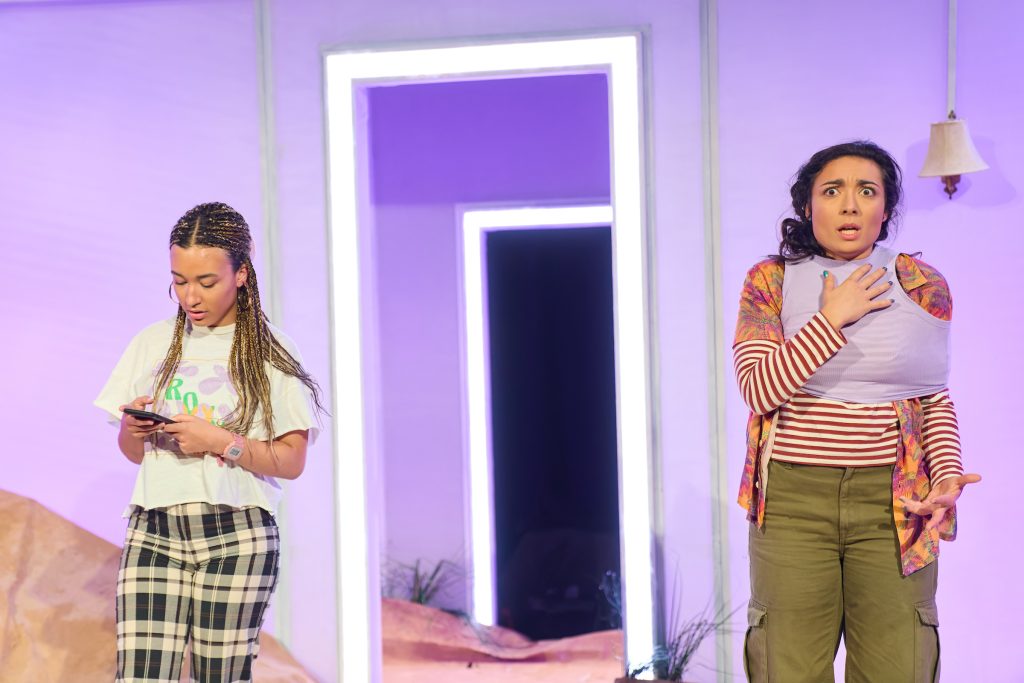
What is striking about Welsh play Imrie is its richness. Rich in language. Rich in description. Rich in lighting. Rich in characterisation. This coming-of-age story is like a rainbow bursting into life, pouring its colour out on stage with a vibrancy that reverberates throughout the whole production. Each element resembles a charged particle which, in collision, drives forward a powerful narrative about identity and belonging. It is a tour-de-force in aesthetics, as well as telling of its message.

Credit: Mark Douet

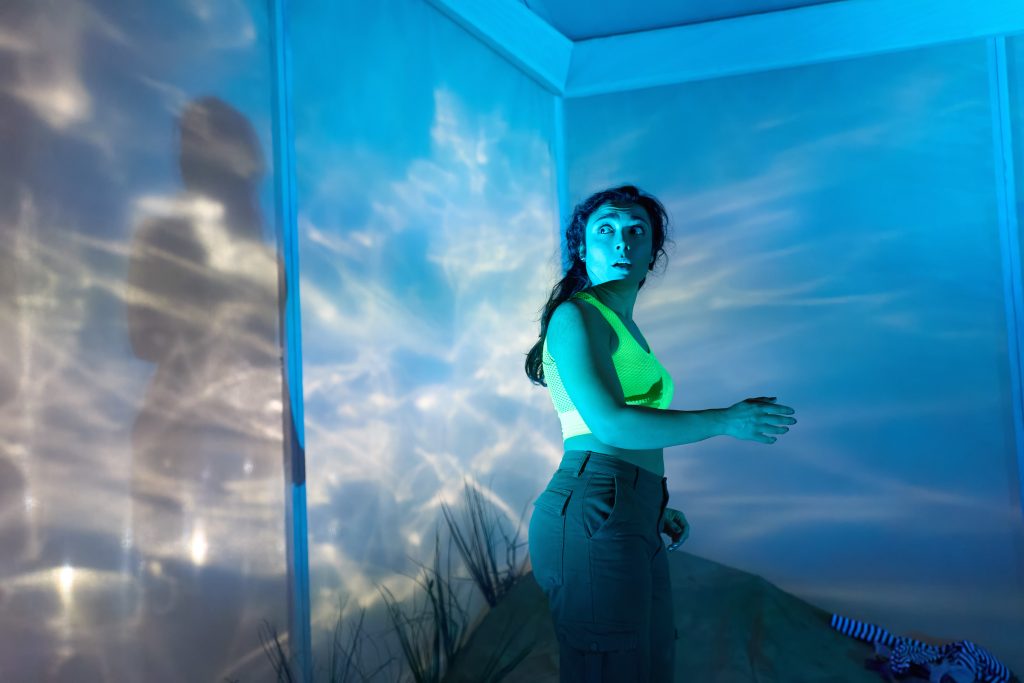
Elan Davies and Rebecca Wilson take on the roles of Josie and Laura in this two-part drama. They are half-sisters seeking to fit in in their own ways. It begins with Laura dragging Josie along to a party on the beach, she wanting to become one of the ‘in’ crowd while her sibling would rather be elsewhere. So while the former attempts to act ‘normal’, the latter runs off, after being made fun of, and finds herself alone with only the sea for company. And when from the water she hears a voice calling, a journey into an otherworldly tale takes place. This ethereal experience is captured brilliantly by the lighting that shimmers and shapeshifts across the three walls of the enclosed set. But it is also the flexibility and freedom of Davies’ physicality that produces beautifully an event which exists between the real and the imaginary.

There are parallels with Caryl Lewis’ recent novel Drift, particularly in relation to the female protagonist. Along with Disney’s Turning Red and The Little Mermaid, it is fair to say that writer Nia Morais has tapped into something bigger with Imrie. Certainly, that desire to break free from the expectations of family and (patriarchal) society burns strong here. To tie it in with the theme and symbol of water gives it a weight that bears down on the scale of contemporary classic. Its relevance is shored up by its exploration of sexual and racial identity. In particular, the conversation between the two characters at the end is thought-provoking, challenging and inspiring in its interaction with intersectionality. This is a further facet to the richness of Imrie, whose immersive soundtrack wraps the audience in its atmospheric tones which, along with the Welsh language, contributes to a mythic quality. Its basis in Cymraeg also adds a poetic lyricism to the dialogue which, though stereotypical, actually strengthens its value as a cultural expression of (self-)acceptance.

Credit: Mark Douet

Most definitely driven by Frân Wen’s passion for young people, when coupled with the Sherman’s support for innovative new Welsh writing, Imrie becomes a bold piece of theatre. Its message may be common but at its heart is an imagination that beats with such originality that it feels fresh. Celebratory of life, even as it depicts its struggles, Imrie reveals something of how identity blossoms, arising out from the depths to become all that we are, rich in colour. A play to be enjoyed whatever age you are.


Originally written for and published on Get the Chance on June 9th 2023.

Steeltown Murders – BBC Wales

Steeltown Murders may be yet another Welsh drama in the ever-popular crime genre, but it is very well done on the whole. Telling the true story of how DNA was used in a pioneering way to solve a cold case in Port Talbot, it flits between the 1973 setting of the murders of three girls and the early 2000s with ease. Starring Philip Glenister, whose accent was nicely perfected through immersion into his Welsh roots, alongside Steffan Rhodri, who play the chief investigating officers, it is a drama that is understated, and effective as a result. Verisimilitude permeates its presentation, and is its greatest strength.

The aesthetic is beige and brown, particularly in its 1970s scenes. The “present” day has a drop more colour but remains blunted by a noirish sensibility. It suits the story and the location well, the unsolved murders hanging over the families and wider community like the smoke from the factories. When music is used, it is in a typically melodramatic way, especially over highly emotional scenes and end-of-episode montages featuring the various characters that come into play. The cast is large, a result of spanning over two timelines partly, but even when each is considered separately, Steeltown Murders feels like an ensemble rather than a two-man show. Glenister’s DCI Paul Bethall is well-drawn – strong-willed, single-minded, haunted by the past – as is Rhodri’s DC Phil Bach – dry-humoured, attentive, poised. But even bit-part characters such as Seb, played by Matthew Gravelle, husband to Sita (Natasha Vasandani), who was two of the girls’ friend, is complete enough to add real weight to the narrative, particularly in its final episode. Whether this is down to its basis in real events, and therefore people, is open to question but, even in spite of this, every actor appears to embody their character with respective heart and attentiveness.

There is the slight criticism towards exposition, and explanation of the forensic and scientific methods that sound plainly for the audience’s benefit. This takes away slightly from its realism which is nevertheless strengthened by the localised accents on show and a bilingualism which, though under-used, was still welcome insofar as representation is concerned. Never for a moment can Glenister be thought of as merely a star signing, his commitment to the role and the overall drama depicted as much in Bethall’s seriousness as his relationship with Steffan Rhodri. The two make a great pairing, sparring off one another with an ease and respect that lightens the dark tone of the narrative. They never dominate the screen however, meaning that the case itself always takes centre-stage even when their part in it is pivotal.

This four-part drama may not be ground-breaking in-and-of itself but Steeltown Murders does tell a ground-breaking story of how DNA technology was used to catch a killer. As such, it is simple but effective; good at what it does, without breaking any new ground.

Click here to watch the series on BBC iPlayer.


Originally written for and published on Get the Chance on 3rd June 2023.

Amy-Jo – Caught Me on a Bad Day

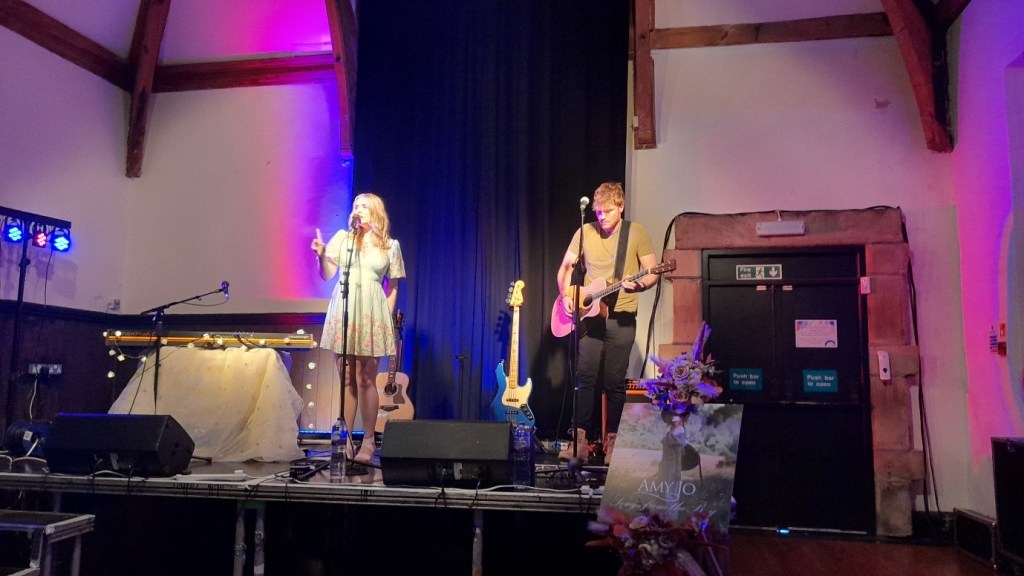
Few artists create catchier choruses than Amy-Jo. The final song to be released from her ‘Songs from the Bay’ EP has perhaps the most persistent of all. ‘Caught Me on a Bad Day’ wangles its way into your ear to become a constant riff in the mind. The lines “If only you’d seen my last Friday night / red lipstick and a dress that fits just right” are particularly guilty of playing over and over for hours after first hearing them. Other lines, such as the playful “I put my socks on but they weren’t a matching pair”, are equally memorable. In other hands, they could be condemned as cheesy, but in the honest and frank world of Amy-Jo, they add real value to her story. In this instance, it is about bumping into an ex just three weeks after splitting up, and doing so at a time when she didn’t look her best. Dealing with the subject of appearance is always apt in our image-obsessed age, requiring a deftness that Amy-Jo achieves with ease. She walks the way between expectation and reality well, perfection being presented as both an ideal and a truth. The former is desired in order to appear fine but really it is the latter – being “happy in my skin / even with no make-up on / and a spot on my chin” – that is to be welcomed. This makes it yet another relatable song from the pen of an artist whose debut EP is among the best that the UK Country scene has to offer. Superb in every way.

You can read reviews of each of the songs from her ‘Songs from the Bay’ EP here.

Neeve Zahra – Country Kind of Love

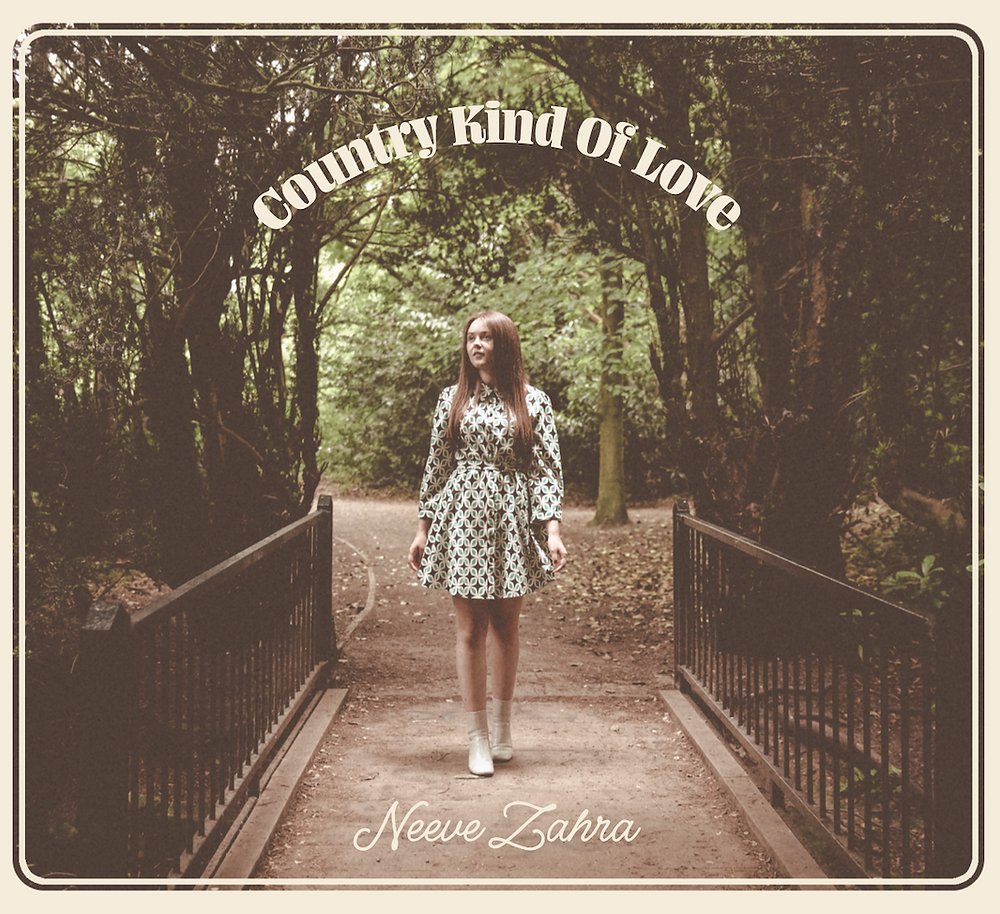
There aren’t many stronger debut EPs than Country Kind of Love by Neeve Zahra. The Manchester-based artist has produced not only a very professional-looking record but its five tracks also exude a quality that belies her early-stage career. There is a lovely lilt in her voice which, along with the high notes she often hits, remind me very much of Katy Hurt. In fact, it is her own debut EP, Pieces of Me, that kept cropping up in my head as I listened to Neeve’s vocal, a similarity that is meant as the highest compliment.

The pieces that Neeve deals with on Country Kind of Love are the different facets of the EP’s title. She takes us on a journey from romance to heartbreak, regret to redemption; fighting back against the dark to break through into the light. She does so with such overt emotion that it achieves what all the best Country records do: a punch to the gut and an arm around the shoulder. She lets you know when she’s hurting as well as defying and celebrating her best self.

The music that accompanies her lyrics is perfectly chosen. From the bias toward the guitar on opening track ‘Because I Love You’, squeezing out love like a fresh zesty lemon, to the addition of the pedal steel on ‘Spotlight’, which poses a reflective and uplifting backdrop, the choice of instruments is pivotal to capturing the subject of each song. None more so than the acoustic setting of ‘Beverley’s Song’, to make it by far the most affecting on the EP.

There are certain lines that cut through in each of the tracks, which sum up their message. On the latter, “Cos your words can chip away / And maybe in your world it’s just ok” underlines the thoughtlessness that can go into speech, particularly in our instantaneous, social media age. It’s a reminder that our words can have an effect, be they positive or negative, so what we say really matters. On Country Kind of Love, Neeve Zahra demonstrates both sides, as well as turning one into the other, as on ‘Spotlight’: “you did me a favour cos I found myself when you broke my heart in two”.

Her capacity to bring such strong emotion to creative storytelling, emphasised by some inspired instrumentation, makes Country Kind of Love a superb addition to the UK Country Music scene. Neeve Zahra is undoubtedly part of the next wave of female artists that will set it alight.

Jodie Marie – Polar Night

Three weeks in the Arctic Circle has certainly left its mark on Jodie Marie. The Welsh singer-songwriter’s new EP shivers with the cold fjord breeze and echoes the icy terrain of Norway’s northern tip. Yet there is also a log-fire intimacy and crunching of soft snow in its sound. It evokes a wild landscape of welcome and wonder. Polar Night is firmly rooted in the geography of its creation.

Opening track ‘Seiland’ plunges the listener into the frozen setting of Jodie Marie’s base with a continuous choral hum. Its simplicity is a theme that defines this record, here manifested in a short instrumental arrangement that tingles the senses. There is a wonderful incongruity between the constraint and freedom of her isolation. This is expressed in the rich combination of soulful vocals and balladeering piano which run through the rest of the record like a stalactite. Meanwhile, lyrics such as those on the title track – “biting wind / I’m frozen here / at the water’s edge / I feel free” – and ‘Blue Hour’ – “I’m lonely / but I feel alright” – act as a stalagmite that meets in the middle to create a solid pillar of yearning love.

The idea that absence makes the heart grow fonder becomes more explicit as the record progresses. And as it arises from the environment in which Jodie Marie finds herself, the songs are ripe with imagery and metaphor. There is something of the sacred in being “surrounded by beauty / and all I see is you” on ‘Blue Hour’. The wooing harmonies conjure up a whooshing wind on ‘Eye of the Storm’, tempered by the comfort of the electric guitar strings, resembling the arms of a loved one. Meanwhile, the stars become a focal point on ‘Closer to You’, the line “miles apart / but we share the same view” reinforcing the intriguing contrast of separation and connection found throughout the EP. It seems this Scandinavian island offered something more than just creative inspiration for Jodie Marie.

Final track ‘Reindeer Heart’ encapsulates the gentle nature of this EP musically whilst also reaffirming the metaphorical link between landscape and love in its lyrics. There is something mystical about this final song, borne of sensitivity and encouraged into being, as a presence that “leaves no traces… that the eye can see”. It is more in the vein of ‘Carageen’ than anything else from her last album ‘The Answer’. But whilst that arose from the Pembrokeshire shoreline, Polar Night was formed amidst the darkness of the far-northern hemisphere. Jodie Marie has captured this setting perfectly, so that even in the midst of its warm Spring release, its sense of place can be keenly felt, and when the sun goes down, embraced.

‘Polar Night’ is out now. Listen to it on Spotify here and/or order a physical copy of the EP here.


Originally written for and published on Get the Chance on May 13th 2023.

Morganway – Back to Zero

Morganway are back with a second album that is as eclectic as their first. Still refusing to be defined by genre, ‘Back to Zero’ sees them blend Folk, Rock, Americana and Indie Pop effortlessly across nine tracks. Their ability to fuse so many different elements is second to none. It has become their signature style. It makes their music both endearing and enchanting. It never fails to please.

Right from the opening bars of ‘Wait for Me’, the sound of Morganway rings out. Several instruments pile in almost immediately, to be joined by the distinct vocals of leading lady SJ Mortimer shortly after. The track is a great euphony of sound. Nicole Terry’s fiddle in particular cuts through the chorus beautifully, as it does on ‘Come on Over’. Here, it complements the sharpness of Mortimer’s vocals to help push through the strong, independent message of the song. Moody guitars transform into synth-laden strings which eventually soften into background acoustics on ‘World Stopped Running’. This indie-folk track is hugely uplifting, in the same way as ‘London Life’ and ‘I See People’ were on album one. The lightness of frontman Callum Morgan’s vocal contributes to this alternative to the more rock-ready tracks on which Mortimer so often serves to powerful effect. It brings a nice contrast which showcases the breadth of the band’s overall sound.

Their extensive range is not just found between songs but in them too. ‘Burn Every Page’, for example, contains both Celtic Folk and Soft Metal, undergirded by Blues and a touch of Rock. It could not be further from its neighbour on the album, ‘Sweetest Goodbye’, a piano-led love letter that presents a rare chance to hear SJ Mortimer perform in a stripped back setting. Co-writer and keyboard player Matt Brocklehurst cites Joni Mitchell as an influence here, a far cry from the Scouting for Girls resemblance that follows on ‘We Were Going Nowhere’. The Morgans’ indie-pop vocals inject some fun into this track, mixing well with the folk-filled fiddle to present an interesting generic hybrid that only Morganway could produce.

The title track is the culmination of this experimentation with sound: a celebratory track that is nevertheless reflective; two-toned in its flavour and coated in a magnificent musical icing. It offers in its lyrics the chance to reset, a theme which punctuates the album but is fully realised here. It is classic Morganway; the closest one can get to offering a definition of their music. Not that they seek to erase what’s gone before. Far from it. But it does make the case that, just as people were suitably raving about their self-titled debut, so they should praise this excellent follow-up. For it is not so much ‘Back to Zero’ as a seamless continuation of their previous catalogue of songs.

‘Back To Zero’ will be released on all major streaming platforms from 5th May 2023. You can pre-order the album on BandCamp here.


Originally written for and published on Belles & Gals on 2nd May 2023.

Featured Image (C) Morganway

Country on the Coast 2023 Festival

It’s not how a festival begins but how it ends that counts. That was my mantra for this weekend’s Country on the Coast in Southsea. For a delayed and diverted train journey from North to South meant that I missed the official start of the festival. And then, when I finally arrived, to the sound of Savannah Gardner’s jazz-inflected Southern drawl, not even the full-on rock of Elliott Joseph who followed could keep my anxiety-induced tiredness at bay. So I hit the hay (not literally, you understand), catching up with Nicola Harris’ and Bob Fitzgerald’s sets via Instagram the following morning.

Suitably refreshed, and after a morning walk along the promenade, I headed back to the pier for day two at the Gaiety Theatre. No bigger than a conference room, it is surprisingly spacious but ideally intimate, Ollins Lande’s meandering Americana vocals contributing to a cosy and easy-going festival vibe. Megan Rose then picked up the tempo with ‘19’ and ‘Tipsy Friday’, songs with such catchy choruses that only someone as talented as Olivia Lynn could match them. Even before her barnstorming performance, she undertook a soundcheck which had the audience enraptured. Take that vocal and mix it to music and we were treated to a fine half hour of emotive storytelling, Lynn balancing the pop with the acoustic well to showcase her already-impressive catalogue.

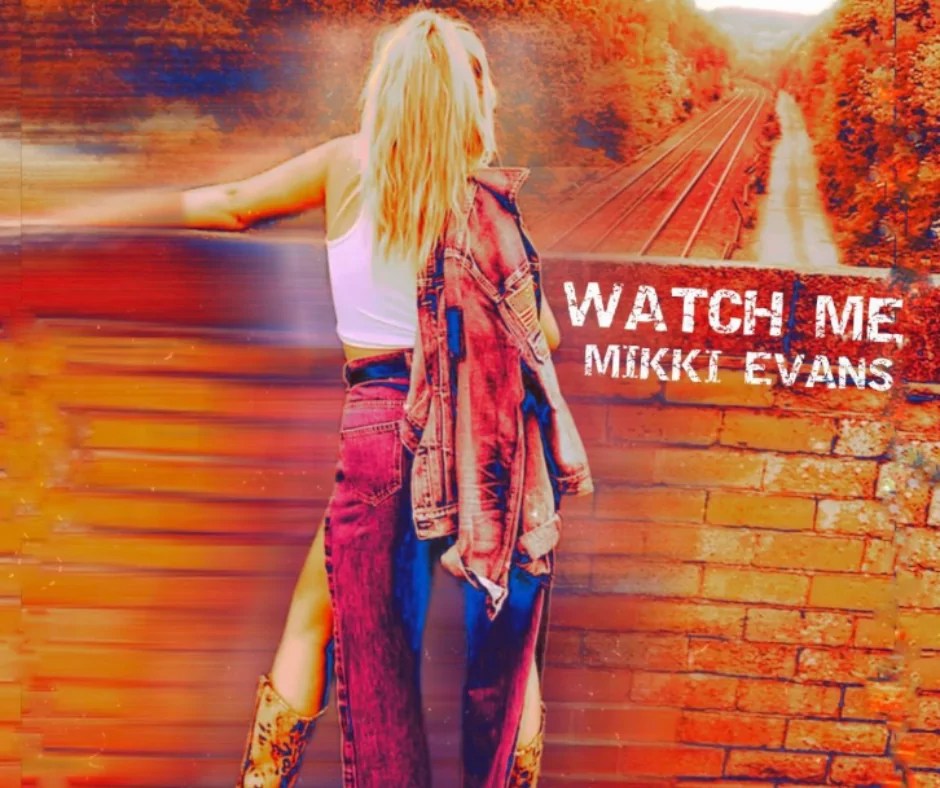
In some ways, she could not have been more different to Dusty Moats, whose smooth and slow Texan Country also contrasted with Abi Orfila’s country-pop sound. This difference in style continued across the rest of the bill, going from the more traditional, acoustic performances of the Songs and Stories Collective to Georgia Nevada’s entertaining mix of noughties pop-rock and ‘50s rock ‘n’ roll. Emma Svensson, in a rare UK appearance, then offered a series of songs that featured an equally-rare appearance of a pedal steel guitar. Given that the instrument used to be a staple of Country music, it shows how wide the genre has grown to incorporate the hard rock of the Heartland Roots Band and the contemporary pop of Mikki Evans. In spite of this, storytelling remains a core identity which binds them together. And there are few better storytellers on the UK scene right now than Alan Finlan. Back to headline Saturday night after his successful appearance last year, the Lee-on-the-Solent native put on quite the show for the hardened few that remained. His set was shot through with humour; an amiable stage presence matched by the playfulness of his lyrics. Many songs contain a clever subversiveness; a studious creativity that duly earns him comparisons with Luke Combs. It meant that those who stayed were treated to an outstanding performance which included excellent cover versions of ‘Johnny B. Goode’ and ‘Bad Moon Rising’ alongside worthy originals like ‘No Money by Monday’, ‘Making Your Mark’ and ‘Passenger Seat’.

Not content with headlining, Finlan was then back for day three, filling in for a last-minute drop-out as part of the festival’s Songwriter’s Round. Joined by producer Tyler Spicer and Pembrokeshire’s Rosey Cale, the three delivered an inspiring 90-minutes of musical prowess. It was particularly lovely to see the relationship between the three develop, a unique feature of the Round. The combination of Cale’s honesty, Finlan’s wit, and Spicer’s quietly spoken manner produced a lovely openness and respect, perfectly suited to a Sunday afternoon. It made for a pleasant listening experience, summed up by the smile on Finlan’s face as Rosey performed her aptly-named, as-yet-unreleased track ‘Blue Skies and Tan Lines’.

It certainly brought an extra shine to what was already a bright and breezy day, not only outside but courtesy of the delectable sound of Adele & Andy too. Adele’s soaring vocal is always a pleasure to hear, and makes even the most poignant of songs fly pretty. Previews of ‘You Left Me Lonely’ and ‘Since the World Turned’ left much to look forward to about their new album. Hers were not the only utterances though, on a day that featured a significant roster of female artists. Beginning with Amie Knight and continuing with Biddy Ronelle, this was a showcase of the immense talent on the UK Country scene right now. Never mind Ben Sellick, who delivered an excellent early evening set full of Blues, Soul and trappings of Rock ‘n’ Roll. For as good as he was, Caitlin Mae surpassed not only him but most others too, to be one of the standout performers of the whole festival. Her professionalism is evident, testament to being “married to my music”. From the motif and logo stage-side to the way she presents between and during songs, she has clearly honed her craft to a level very few achieve at such a tender age. There are echoes of Taylor Swift in her mannerisms; coming out into the crowd at one point displaying a confidence unrivalled. ‘Getting Over You Boots’ was a particular highlight, along with set-closer ‘Fiona’, as brazenly delivered as one might expect.

Very few would have been able to follow that. Louise Parker took it all in her stride. ‘Little Bit Drunk’ was in some ways the epitome of her emotive and stylised persona; her performance of ‘Fool’s Paradise’ containing that essential mix of light-touch vocal, spoken word delivery, and playful action that meant she presented as nothing other than herself. Such self-effacing honesty is what makes her music so enjoyable, a rendition of ‘Never Gonna Give You Up’ slotted seamlessly into ‘Tequila Sunset’ being one example of her unending ability to entertain. So much were the crowd not wanting her set to finish, she agreed to an encore, ‘That Don’t Impress Me Much’ bringing the curtain down on a weekend of family-friendly revelry. Whilst Shania might be hard to please however, Country on the Coast left me not only impressed but celebrating its success. This is not least down to the hard work of founder and director Hannah Roper, who has put on a festival not only to be proud of but that deserves to grow.

Country on the Coast is an annual festival that takes place at the Gaiety Theatre, Southsea. To find out more, visit www.countryonthecoast.uk.


Originally written for and published on Belles & Gals on April 27th 2023.

Featured Logo (C) Hannah Roper

The Round Up in Liverpool

Songwriters’ Rounds contain three key ingredients which, when mixed together well, ensure their success. The Liverpool leg of The Round Up tour had great songs, stories and camaraderie in spades. Two Ways Home were joined by Katy Hurt, Demi Marriner, and Robert Vincent for a night that delivered plenty of laughs, delectable lyrics, and a warm atmosphere that made Phase One feel like a home from home.

The venue had undergone a wholesale change since my last visit pre-pandemic. Now, walking through the courtyard to enter, I was greeted by a fully-refurbished interior that made for a more intimate space. Wooden tables and chairs, compact and cosy in their layout, were dotted between bar and stage, with a couple of sofas in front of a jukebox in the far corner. It was an interior that lent itself to the informal, stripped back nature of the Round. The artists appearing mingled amongst the crowd pre-show before taking their places on a cramped stage. Guitars were squeezed this way and that but there was no complaining, no jostling; only jollity and revelry between them throughout.

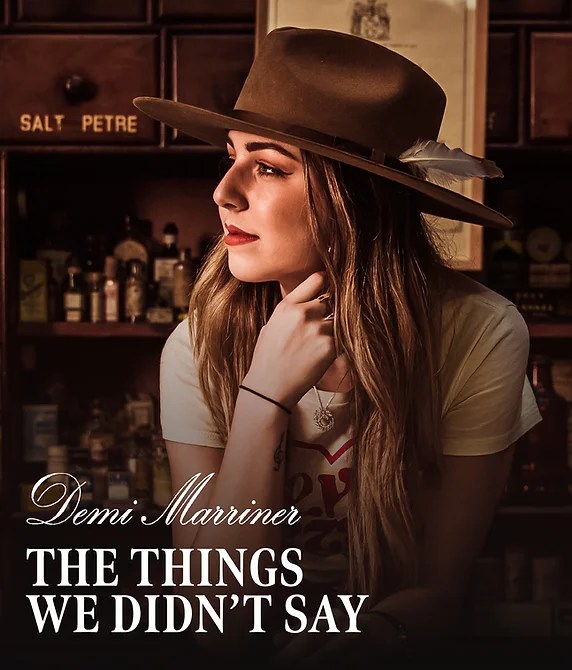
Not even an early technical hitch with Robert Vincent’s guitar, after Katy Hurt’s impressive opener with ‘The Kiss’, was going to affect proceedings. For whatever was thrown at them was met with an easy-going response. This made the evening ebb and flow with much greater emotion and freedom. Vincent’s funny interludes on stage contrasted well with the serious depth of his songwriting. One after another, his songs punched through the Saturday night air, urged on by strong vocals heavy with the wisdom of lived experience. Each time, Demi Marriner rose to meet him. Her self-titled “waffle” before each song was entertaining but was matched with a quality of lyricism that meant no one could take her for a fool. Whether the gorgeously poignant ‘Don’t You Worry’ or the heartbreakingly inspiring ‘Little Boy’, she delivered a beautifully chosen set of songs from an upcoming debut album now highly anticipated after this performance.

It was not just Demi who received whispers of approval amongst the audience. Newcomers to Katy Hurt’s catalogue were also sharing looks of an impressive nature. None more so than after ‘Revved Up’. Hers is a powerhouse of a vocal on this track, and she seemed to turn it up a further notch here to leave two ladies in particular suitably awestruck at the song’s end. ‘Falling Apart’ may not have pulled at the heartstrings quite as much as it could have done, thanks to some unintended laughter near its beginning. But it did suitably mark the night as one in which emotionally-wrenching lyrics balanced with humorous conversation to make it a highly enjoyable and ultimately uplifting evening.

Two Ways Home seem to have found the secret to compering nights like this. Their light touch made for a fluid gig wherein the relationships between the artists were allowed to grow and flourish naturally onstage. The result was a feeling of not just being invited in to a live session between friends but a homely environment that filtered through to post-show chatter in which any barrier between audience and acts simply disappeared. In that respect, the title of the song they opened with, ‘Closest Stranger’, took on a deeper meaning by the end of the night. If this is the kind of show that exemplifies The Round Up then it’s worth catching in a town or city near you.

The Round Up is on tour throughout April. For upcoming dates and locations, click here.


Originally written for and published on Belles & Gals on April 13th 2023.

Featured Image (C) Two Ways Home

Eleanor Nelly – ‘Circles’ Gig @ Leaf, Liverpool

The effervescent Eleanor Nelly put on quite the show on Saturday night. With support from Harry Miller and Ellis Murphy, the Liverpool trio brought quite the eclectic Country mix to Leaf on Bold Street. Performing to a mixed crowd of eager listeners and good-time Saturday nighters, their music split nicely between the reflective and the pulsating to offer something for everyone, regardless of taste.

Harry Miller stepped up to the mic first, standing on the Folk end of Rock; producing a sound reminiscent of Oasis but with a distinct Kelly Jones vocal; touching the edges of Americana, as per the Stereophonics-frontman’s new band Far From Saints. With a self-confessed set of “sad songs” nevertheless demonstrating Miller’s super songwriting, his was an opening set of heart-on-sleeve, melodiously-melancholic stuff.

Ellis Murphy, to some contrast, grounded himself more firmly in Folk, clearly influenced by Bob Dylan but displaying a wizened voice of youth. Think Jake Bugg but less of the Pop, as he played old Irish tunes and early Country songs, complete with harmonica to accompany the guitar. It was a fine display of contemporising classics without straying too far from their roots.

The two male artists laid the ground well for the aforementioned Nelly, whose headline set protruded into the crowd with rock star swagger whilst retaining Country’s vulnerability for “three chords and the truth”. After an opening section which defiantly announced her arrival on stage, including a tub-thumping rendition of ‘Colour Blind’, the set proceeded to showcase the breadth of her sound. It ranged from the modern Country-pop of ‘Eventually’ (with Kelsea Ballerini overtones) to the classic sound of Americana-infused ‘Takes a Fool’. To go from the tongue-in-cheek humour of ‘Good Guy’ to the heartfelt ‘Polaroid’, via the anthemic ‘The Best is Yet to Come’, demonstrated the extent of her musical intuition. She is not bound by genre but, like the best songwriters, knows what serves the song best. It is how she skipped from filling ‘Goodbye’ with plaintive attitude to giving ‘Seventeen’ the acoustic space it needed to emotionally breathe.

To end the set with ‘Circles’, thus making reference to the neon curve acting as the backdrop behind, and ‘Time to be Alive’, with its full-on Country-rock, meant a fitting finale to an energetic and at times electrifying show. It evidenced Country’s ability to speak across divides, affording opportunities to listen deeply to the lyrics whilst being able to dance away to the music’s infectious beats. This is what makes Eleanor Nelly such a great artist. She knows how to speak into your heart whilst making sure you have a damn good time.


Originally written for and published on Belles & Gals on April 6th 2023.

Featured Image (C) Eleanor Nelly

Trouble in Butetown – Donmar Warehouse

To see the Wales-based play Trouble in Butetown performed on a London stage was a tantalising experience. This was a rare example of accent and language reverberating around a place not situated within the confines of its nation. To hear Welsh being spoken miles from home in front of a multicultural audience where English was the common denominator was both a surprise and a delight. When coupled with the intimacy of the Donmar, where the audience are immersed right in the action, the familiar phrases, said without translation or explanation, made for an authentic performance that was unexpected but welcome.

The scenery and costume added well to the verisimilitude, transporting us all into the living room of an illegal boarding house in wartime Cardiff. Credit must also go to the dialect coaches who have worked wonders with a cast of mixed nationalities, Sarah Parish among them who, as the matriarch Gwyneth, delivers a voice of which those in the Valleys would be proud. She may be the star name in this production but the star performance goes to young Rosie Ekenna as Georgie. Making her debut on stage, her confident and agile performance belies her nine years of age. She produces a character that is full of attitude and vigour; tough as nails, and a quick wit which is keenly delivered. Her relationship with Samuel Adewunmi, who plays American GI Nate, wanted for the murder of a fellow soldier, is especially wonderful, the two bouncing off one another as equals in both their dialogue and action.

Rita Bernard-Shaw also shines as Connie, an aspiring singer, whose stirring renditions of jazz standards and blues numbers mark her as a real talent vocally. Meanwhile, Zephryn Taitte brings a much harder edge to Norman than Call the Midwife fans are used to seeing (he plays pastor Cyril Robinson in the long-running series). His presence on stage is always evident though never dominant; a character of compassion borne of struggle and hardship. His inclusion, alongside fellow immigrant worker Dullah (Zaqi Ismail), means that Trouble in Butetown portrays what the programme calls the “cosmopolitan community with seafarers from all around the world making Cardiff their home”. In doing so, it cannot help but include racial tensions which, though localised, speak to universal issues, giving voice not only to past generations but present struggles too. This is a story not only of Tiger Bay but contemporary Britain too.

There is a feeling at the end of the play that what has been witnessed is a celebration of diversity. It presents Wales’ capital city as a place of welcome and integration that belies the historical notion of a homogenously white population. It also presents the cultural importance not only of BAME identities but the native language of the nation, included here not as statement or stereotype but as real expression of lived experience both then and now. It challenges the notion, still prevalent in wider society, that Welsh is a ‘dead’ language. Trouble in Butetown plays a small part in taking it beyond the border, and in doing so, communicates cultural inclusion on several fronts.

Trouble in Butetown premiered at the Donmar Warehouse between 10th February & 25th March 2023.


Originally written for and published on Get the Chance on 28th March 2023.

Featured Images (C) Donmar Warehouse