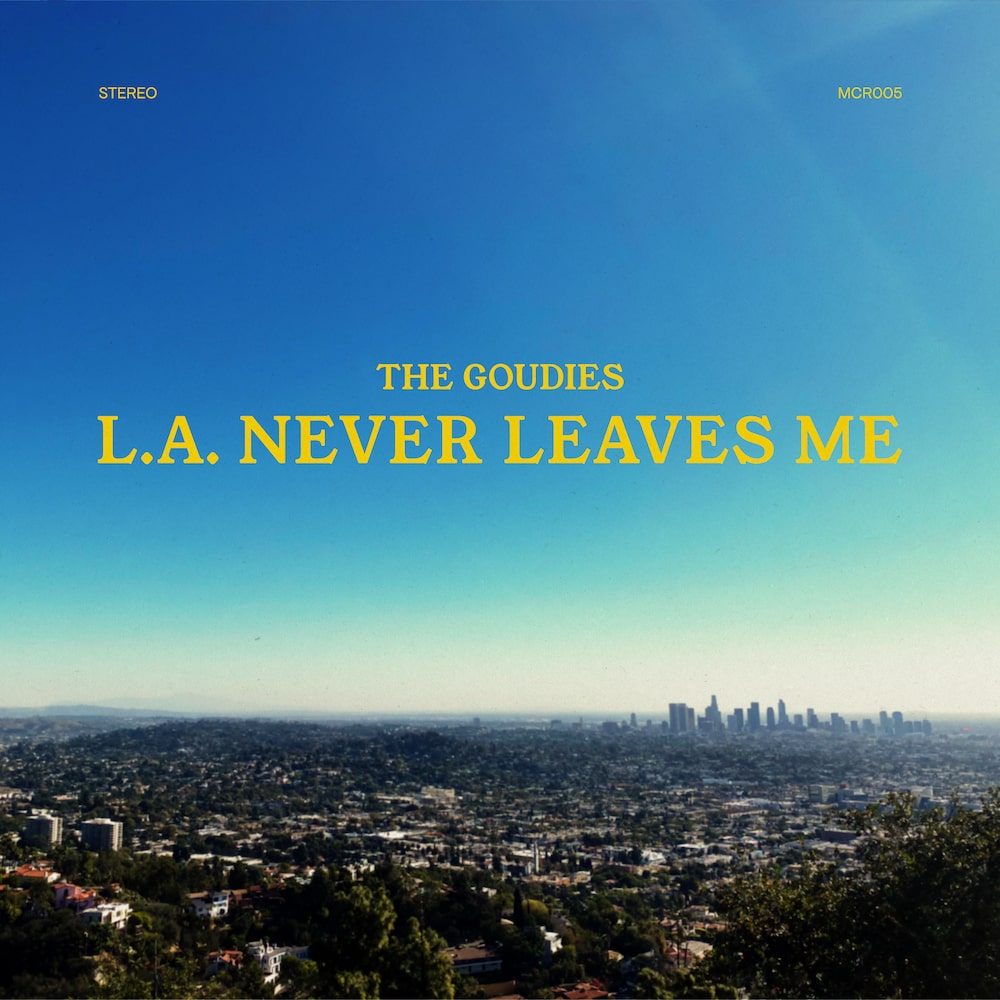
The Goudies – L.A Never Leaves Me

The Goudies are back with a brand new single. ‘L.A Never Leaves Me’ is an ode to the Californian city that they spent a short time in but that made a great impression on them. The lyrics are steeped in longing and affection for its “shores” and “greener grass”, so much so that it writes like a romance. The depth of this love affair is expressed most fully in the lines “I see her in the mountains / and look for her in towns”. Along with “I never really liked the cold”, it does a good job of evoking their present Welsh landscape while seeking after that “something more” which lies beyond, captured in their hearts. This gives the song a spiritual as well as emotional dimension, lending weight to what I think becomes the pivotal line: “L.A never leaves me / I have to wonder why”. When coupled with the dreamy score, it really impresses on the listener the impact the place has had on Beth and Sam. It makes it mark on us like LA has left its mark on them.

Like what you read? Support me in supporting the work of artists and creators by donating to my tip jar here.

Featured Image (C) The Goudies

John Jenkins – Tuebrook

Head east out of Liverpool City Centre and you will come to a suburb called ‘Tuebrook’. The title of John Jenkins’ new album is partly inspired by this place, its artwork a two-up, two-down, red-brick home on one of its streets, familiar to anyone with a connection to this part of the North West. It is where the singer-songwriter grew up, making this a semi-autobiographical record. Containing snapshots of the people and places that he remembers, he also combines fictitious elements nevertheless inspired by this location. All told in a very stripped back style, his songs become intimate stories that are keenly felt. You don’t have to have been to Tuebrook to experience it for yourself.

It is the incidental details in the lyrics that make ‘Tuebrook’ such an interesting listen. Whether the “Road to Nowhere” highway that had such a devastating impact on local places, or the “dirty faces, sore knees…, scrubbing our hands in margarine” of childhood shenanigans, both ‘Shadows’ and ‘Christopher Roberts’ evoke situations and circumstances that are specific, but speak to something more universal. The former really does convey something of its first word, “discontented”, pushing it to the verge of despair. The only thing that stops it, and the album, from falling into an abyss is the soft, wispy vocal of Jenkins himself. There is a ray of hope always in his delivery; understated but present at all times. It contributes to a lovely reworking of ‘Wayfaring Stranger’, the lines changed absolutely while the tune remains to create ‘Idaho’. It is the most Country-sounding track on the album but doesn’t feel out of place despite its geographical difference.

The rest of the album is mostly steeped in Americana, though evocative of Paul Heaton & Jacqui Abbott’s folk-pop, but without the heavy production. Most of the time it is just Jenkins and his guitar, who will perhaps pick up the tempo now and again (‘Passing Time’) but mainly sails across calm waters. The subject matter may cause a ripple, like the piercing final verse on ‘43 & Counting’ – “And I feel so old / Silence has spread through this house and my soul / Separated like a leaf from its tree”. It doesn’t last though, as the light jazz on ‘Child’s Sense of Wonder’ for example, brings a playfulness that, on this occasion, is also ground in recognition. Jenkins’ songs always feel close to home, achieved most readily through a refusal to unfold his tunes into heavy pop production. Add in a wistful voice full of reflection, and they become as inviting as those of Suzanne Vega. None more so than ‘Lost in the Storm…’.

The final track, ‘Mr Ford’s Hardware Store’, truly grounds the listener in a reminiscence of a bygone age. Sung by children to give it that extra taste of memory, it fits perfectly with the loose concept of this album, bringing to life an area still fondly held by John Jenkins. Tuebrook may not be well-known beyond its Liverpool locality but it is honoured rather beautifully here by one of its most musically-talented proteges.

Like what you read? Support me in supporting the work of artists and creators by donating to my tip jar here.

Featured Image (C) John Jenkins

Jeorgia Rose – Boxes

Songs on the loss of childhood innocence hit me harder these days. Since turning 30 I’ve done a lot of self-reflection on adulthood so far and hankered after simpler times in the wake of unmatched expectations and life choices. So hearing Jeorgia Rose speak about such things on her latest single ‘Boxes’ has been a cathartic experience. Much like ‘Girl Who Didn’t Care’, by Tenille Townes, it looks back on the carefree and uninhibited younger self. While both celebrate this persona however, Townes’ song contains an element of hope which ‘Boxes’ seems to be lacking. For Jeorgia Rose appears to be mourning her passing without any hint that “she’s still in there somewhere”, to quote Tenille. The simple and sensuous pop elements of the production add to this sense of sadness, as contentment gives way to self-consciousness and concern replaces assuredness. It is a much more fragile expression of the theme, which makes its vulnerability more potent. Certainly, the central image of the compartmentalisation of life into boxes resonates keenly, with an honesty that resembles kinship. So as much as Tenille Townes offers the possibility of redemption, there is something about its absence in ‘Boxes’ that allows Jeorgia Rose to offer a different sort of comfort. One in which she meets you where you’re at, and gives recognition to how you feel; looking back fondly on the past even as a return to it is out of reach.

Like what you read? Support me in supporting the work of artists and creators by donating to my tip jar here.

Featured Image (C) Jeorgia Rose

Mikki Evans – Watch Me

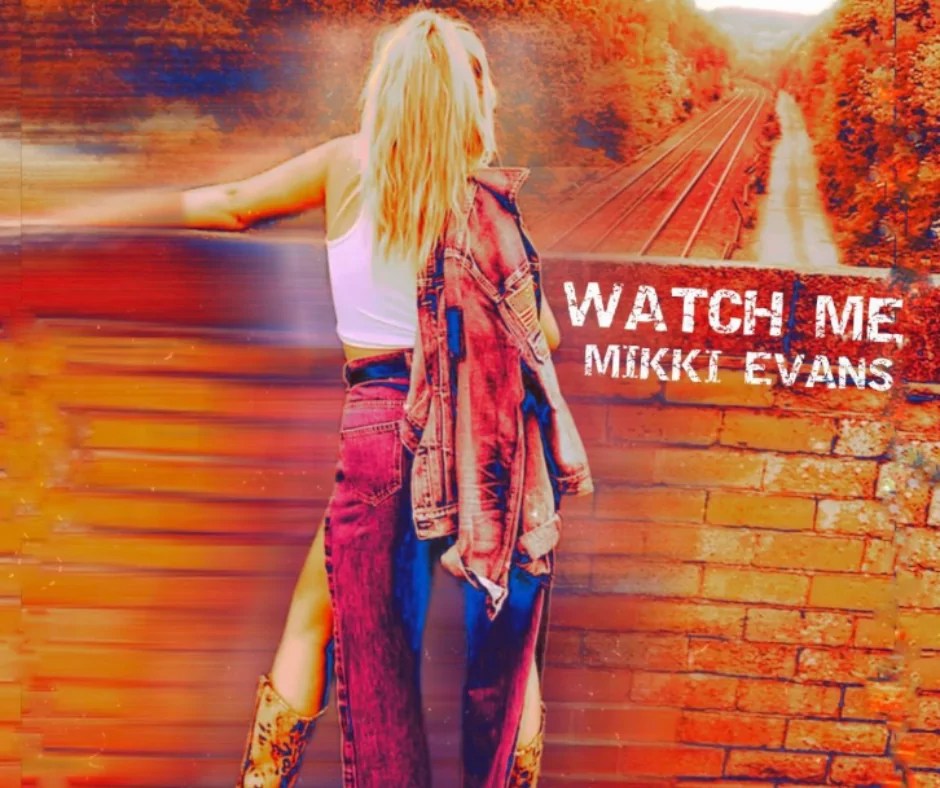
Mikki Evans turns from pop to rock on her latest single ‘Watch Me’. The Country artist shows another side to her music with this low-toned, dirt-road offering. The presence of electric guitars and heavy drumbeats add significant attitude to deliver a strong statement of intent. It is made at the very start in the lines, “They said I was a weak one / never be someone / funny how the table’s turned”, and continues likewise into a chorus full of defiance. Two images in particular stand out: “watch me lose control / like the meanest bull at the rodeo” and “I’m as free as the air you breathe”. Both lines convey the strength of self-belief well; the refusal to be put down by those who seek to “drown my dreams in gasoline”. Instead, Mikki uses such fuel to make the passion inside her burn stronger, making this song an anthem for the denigrated and disparaged.

Like what you read? Support me in supporting the work of artists and creators by donating to my tip jar here.

Featured Image (C) Mikki Evans

Demi Marriner – The Things We Didn’t Say

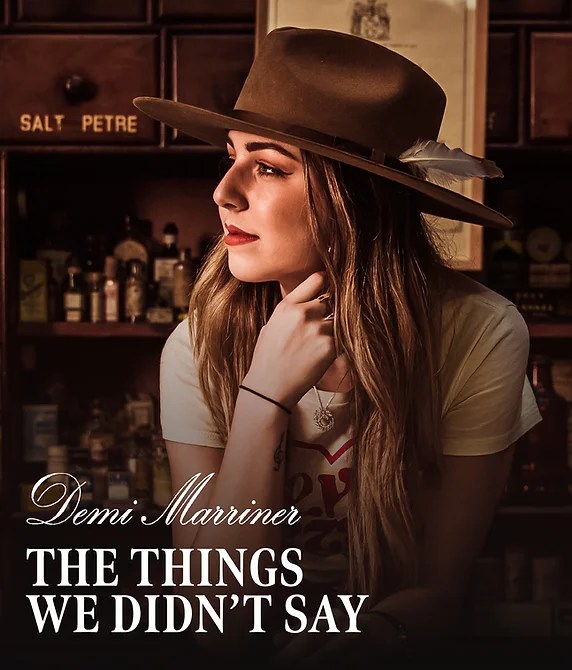
It is the things that Demi Marriner does say on her album ‘The Things We Didn’t Say’ that make it such a pleasure to listen to. Lots of lovely lyrics – whether single lines, paired rhymes or whole choruses – that wheedle their way into the ear. Wrapped in the broad genre of Americana, they sit neatly as a collection of emotional portraits. Love, regret, hope and loss are all on display on a record that finds her voice front and centre. She is a woman of words, and how beautifully does she put them together.

No doubt influenced by Elles Bailey, for whom Demi is a backing singer, opening track ‘Sins’ begins with an infusion of Gospel-Blues. The low basslines and high-pitched slides of the first minute’s instrumental sets the scene nicely for the potential that bubbles in a relationship where “troubles at the door / and I’m thinking about letting it in / but are you worth my sins?” This theme carries loosely into ‘Distorted Desires’, already a hit single, largely because its chorus is something special. A winning mixture of acoustic rhythm, lyrical arrangement and vocal dexterity make it so. But it’s also the gentle confidence with which its told that elevates it to a plain on which its deconstruction of forbidden love is unequivocally achieved. It matches the emotional heft of ‘Little Boy’, but in a very different way. For though both songs could be considered a form of encouragement, the basis of ‘Little Boy’ is advice rather than challenge. Written after the birth of her cousin, Demi pours the lessons of life into this track with sagacious enthusiasm. The subtle shift from “you won’t…” to “we don’t…” that precedes the line “…always get it right the first time” shows a shared vulnerability which makes for a sweet and poignant message.

There is also a poignancy to the other family-inspired song on the album. ‘Mother’ is the first of two that have graduated from her ‘Dandelion’ EP, this being a gently anthemic celebration of a pivotal figure in Demi’s life. Fragility is not shied away from; in fact, it serves to strengthen the bold images in its chorus. These range from “a robin floating in the breeze” to “a flower in a field of trees”, “a lighthouse to guide a sinking ship” and “a fighter for what she didn’t get”. Such descriptions are as uplifting as they are moving, and sit comfortably alongside a growing canon of maternally-inspired material, including ‘Mamas’ by Anne Wilson and ‘Mother’ by Kacey Musgraves.

The track that follows, ‘Don’t You Worry’, also has a mother-daughter relationship vibe. It is also unashamedly old school Country, especially in its sound. The simplicity to this toe-tapping arrangement brings a warm smile of appreciation before the familiarity of Demi’s signature tune, ‘Cold Coffee’, invites it to stay. The song still possesses one of the best lines in UK Country Music – “You’re like cold coffee / you tasted better the first time around” – told with a deftness that renders it sublime. Only ‘The Light’ could follow it as a fitting final track, with a rousing orchestral finale that brings the curtain down on an album with much to say. The artwork on the cover is reminiscent of ‘Sounds Good in a Bar’ by Katy Hurt. And many of these songs will. For Demi Marriner is a gifted storyteller and songwriter, of the same class as both Bailey and Hurt.

Like what you read? Purchase some beautifully-designed merch from Demi’s website here. Support me in supporting the work of artists and creators by donating to my tip jar here.

Featured Images (C) Demi Marriner

Kezia Gill – Misfit

Even as the multifaceted nature of Kezia Gill’s music is revealed on her new album ‘Misfit’, there is no sense that the songs contained within it are at odds with each other. That doesn’t mean that it isn’t surprising but it is far from jarring. Different genres blend together nicely. Styles weave seamlessly in and out. There may not be a single definition for it musically but that is exactly part of its appeal. It’s an album that seeks to portray the “bit of everything” that makes Kezia Gill who she is. And it does just that in her own distinct way.

The title track opens up proceedings in a suitably rock-heavy style. Kezia announces with confidence that “I finally know my place”, among those who don’t feel like they fit, or can be put into a box. Its message is uplifting; relatable or encouraging depending on individual circumstance. Not to say that comparisons cannot be made. The popular single ‘Whiskey Over Ice’, an arena-worthy tune with a lyrical emphasis even as it is surrounded by guitars, has strong Ashley McBryde vibes. And the piano-led ballad ‘Like I Did Before’, with the line “I don’t know what happy is” hitting like an emotional bullet, is reminiscent of Megan O’Neill at her vulnerable best. Start to understand her though, and a song like ‘Tonight’ comes along as a reminder that she evades easy classification. In this instance, it throws a curveball through the presumption that Kezia Gill is a powerhouse vocalist. The softness of her voice here is totally unexpected, even as it suits the Folk-style arrangement. She is nothing if not versatile.

‘House on the Hill’ is a high-point on this album (no pun intended) from a Country point-of-view. Not only does it carry a lovely guitar riff throughout but it tells a story of home that is utterly endearing. Much like ‘Dime Store Cowgirl’ (Kacey Musgraves) reflects on the inherent roots of identity, so this track finds that the journey always leads back to whence it came. In this case, it is to a “holly tree and our number on the door” – imagery that is as compelling as the narrative. It is where Kezia Gill finds her true self: the one behind the performer. A house of contentment, one might conclude, in contrast to Miranda Lambert in ‘The House That Built Me’.

‘Smokey’ reminds listeners that the hard, head-banging Blues to which she is accustomed still exists in her wide-ranging repertoire. The guitars then slide nicely into ‘Sweet Spot’, presenting more of the same but with a chorus so instantly memorable, it is ripe for audience interaction. Throw in ‘No Idea’, with its comedic honesty and light irony, and this section of the album harks back to the ‘Dead Ends and Detours’ EP which first announced her on the scene. Her stock has risen considerably since, and no wonder, given the quality of songwriting, not only on the latter but the final two songs on the album. ‘Price of Loving You’ is a complete gear change, emotionally-charged in its message of sacrificial love. Meanwhile, ‘Dear Me’ is a highly reflective note-to-my-younger-self, an acoustic wonder made more so by the musing violins.

It brings to a close an album on which Kezia Gill has found her place in the world, and the industry, embracing every facet of her musical being to be a ‘Misfit’ who fits perfectly in the in-between.

Like what you read? Support me in supporting the work of artists and creators by donating to my tip jar here.

Amy-Jo’s Hometown Show

There is a lengthy queue forming way before the doors open on Amy-Jo’s hometown show. People are packed like sardines in the entrance, clearly eager to take a seat in the quaint hall of the Gregson Arts and Community Centre. I catch bits of their conversation from my seat in the bar opposite, discovering that they are a heady mix of family, friends, and supporters from the wider community. One or two appear to have stumbled across it on the off-chance – “I hadn’t realised there was a singer on tonight” – “I saw the advert” – “Are there still tickets available if I pay now?” Such are the roots of the independent musician’s story, and Amy-Jo is no different. Yet as much as growing a fanbase is hard-won, I suspect, given the performance that ensues, that those new to her music will not have taken much convincing that she is indeed a rising star.

For beneath the wooden beams and cream-coloured walls of this community venue, Amy-Jo exudes a professionalism that warrants a much bigger platform. She strides onto the stage with unassuming confidence; bright and breezy; and greets the audience with an effervescent smile. It seems she is in part delighted, in part overcome by the turnout, but also, in another sense, simply coming as herself. There is no façade to her performance style. The way she greets and has photos taken with those afterwards proves that. And this sense of unbroken identity is also captured in the songs that she sings. Not only in respect of her original material but her chosen covers too. She stamps her heart on each one, with a style that is inclusive of Country, Pop and Soul.

Set-opener ‘Love Before the Internet’ captures a certain vintage vibe underlined by the chic dress worn by Amy-Jo throughout. She is, in many respects, an “old head on young shoulders”, with a mature storytelling prowess that is encapsulated in a very modern musical sensibility. Tracks like ‘Coming Close’ and ‘Shoulder Pads’ exude this sense of contemporary classic, while her unique take on ‘Dreams’ (Fleetwood Mac) and ‘Jolene’ (Dolly Parton) is like old wine being poured into new wineskins. The strained vocal in which she presents the latter is particularly noticeable in its interpretation, bringing a sadness, almost of despair, not obvious or so overt in the original.

The supreme comfort with which these well-known songs sit alongside material from her debut EP, ‘Songs from the Bay’, is a measure of how accomplished she has become in the craft of songwriting. This is epitomised in the closing numbers of her set: latest single ‘Caught Me on a Bad Day’ is as inducing as Maroon 5’s ‘This Love’. Before this, a piano-led section features an extra show of vulnerability, as the tears flow from ‘Someone You Can’t Let Go’, a heartfelt ballad dedicated to her Grandad. Meanwhile, a special request for The Proclaimers ‘500 miles’ sees kids congregating at the front to join in, following an exclusive performance of ‘Young in Love and Broke’ which has the audience transfixed.

It is no wonder that so many came to watch their local talent and responded with such applause at the end when they are this good. Amy-Jo may be just getting started as a hometown headliner but she has the ability to make an impact far beyond her Lancastrian home.


Like what you read? Listen to Amy-Jo’s ‘Songs from the Bay’ EP on Spotify here.

Imrie – A Sherman Theatre/Fran Wen Co-production

What is striking about Welsh play Imrie is its richness. Rich in language. Rich in description. Rich in lighting. Rich in characterisation. This coming-of-age story is like a rainbow bursting into life, pouring its colour out on stage with a vibrancy that reverberates throughout the whole production. Each element resembles a charged particle which, in collision, drives forward a powerful narrative about identity and belonging. It is a tour-de-force in aesthetics, as well as telling of its message.

Credit: Mark Douet

Elan Davies and Rebecca Wilson take on the roles of Josie and Laura in this two-part drama. They are half-sisters seeking to fit in in their own ways. It begins with Laura dragging Josie along to a party on the beach, she wanting to become one of the ‘in’ crowd while her sibling would rather be elsewhere. So while the former attempts to act ‘normal’, the latter runs off, after being made fun of, and finds herself alone with only the sea for company. And when from the water she hears a voice calling, a journey into an otherworldly tale takes place. This ethereal experience is captured brilliantly by the lighting that shimmers and shapeshifts across the three walls of the enclosed set. But it is also the flexibility and freedom of Davies’ physicality that produces beautifully an event which exists between the real and the imaginary.

There are parallels with Caryl Lewis’ recent novel Drift, particularly in relation to the female protagonist. Along with Disney’s Turning Red and The Little Mermaid, it is fair to say that writer Nia Morais has tapped into something bigger with Imrie. Certainly, that desire to break free from the expectations of family and (patriarchal) society burns strong here. To tie it in with the theme and symbol of water gives it a weight that bears down on the scale of contemporary classic. Its relevance is shored up by its exploration of sexual and racial identity. In particular, the conversation between the two characters at the end is thought-provoking, challenging and inspiring in its interaction with intersectionality. This is a further facet to the richness of Imrie, whose immersive soundtrack wraps the audience in its atmospheric tones which, along with the Welsh language, contributes to a mythic quality. Its basis in Cymraeg also adds a poetic lyricism to the dialogue which, though stereotypical, actually strengthens its value as a cultural expression of (self-)acceptance.

Credit: Mark Douet

Most definitely driven by Frân Wen’s passion for young people, when coupled with the Sherman’s support for innovative new Welsh writing, Imrie becomes a bold piece of theatre. Its message may be common but at its heart is an imagination that beats with such originality that it feels fresh. Celebratory of life, even as it depicts its struggles, Imrie reveals something of how identity blossoms, arising out from the depths to become all that we are, rich in colour. A play to be enjoyed whatever age you are.


Originally written for and published on Get the Chance on June 9th 2023.

Steeltown Murders – BBC Wales

Steeltown Murders may be yet another Welsh drama in the ever-popular crime genre, but it is very well done on the whole. Telling the true story of how DNA was used in a pioneering way to solve a cold case in Port Talbot, it flits between the 1973 setting of the murders of three girls and the early 2000s with ease. Starring Philip Glenister, whose accent was nicely perfected through immersion into his Welsh roots, alongside Steffan Rhodri, who play the chief investigating officers, it is a drama that is understated, and effective as a result. Verisimilitude permeates its presentation, and is its greatest strength.

The aesthetic is beige and brown, particularly in its 1970s scenes. The “present” day has a drop more colour but remains blunted by a noirish sensibility. It suits the story and the location well, the unsolved murders hanging over the families and wider community like the smoke from the factories. When music is used, it is in a typically melodramatic way, especially over highly emotional scenes and end-of-episode montages featuring the various characters that come into play. The cast is large, a result of spanning over two timelines partly, but even when each is considered separately, Steeltown Murders feels like an ensemble rather than a two-man show. Glenister’s DCI Paul Bethall is well-drawn – strong-willed, single-minded, haunted by the past – as is Rhodri’s DC Phil Bach – dry-humoured, attentive, poised. But even bit-part characters such as Seb, played by Matthew Gravelle, husband to Sita (Natasha Vasandani), who was two of the girls’ friend, is complete enough to add real weight to the narrative, particularly in its final episode. Whether this is down to its basis in real events, and therefore people, is open to question but, even in spite of this, every actor appears to embody their character with respective heart and attentiveness.

There is the slight criticism towards exposition, and explanation of the forensic and scientific methods that sound plainly for the audience’s benefit. This takes away slightly from its realism which is nevertheless strengthened by the localised accents on show and a bilingualism which, though under-used, was still welcome insofar as representation is concerned. Never for a moment can Glenister be thought of as merely a star signing, his commitment to the role and the overall drama depicted as much in Bethall’s seriousness as his relationship with Steffan Rhodri. The two make a great pairing, sparring off one another with an ease and respect that lightens the dark tone of the narrative. They never dominate the screen however, meaning that the case itself always takes centre-stage even when their part in it is pivotal.

This four-part drama may not be ground-breaking in-and-of itself but Steeltown Murders does tell a ground-breaking story of how DNA technology was used to catch a killer. As such, it is simple but effective; good at what it does, without breaking any new ground.

Click here to watch the series on BBC iPlayer.


Originally written for and published on Get the Chance on 3rd June 2023.

Amy-Jo – Caught Me on a Bad Day

Few artists create catchier choruses than Amy-Jo. The final song to be released from her ‘Songs from the Bay’ EP has perhaps the most persistent of all. ‘Caught Me on a Bad Day’ wangles its way into your ear to become a constant riff in the mind. The lines “If only you’d seen my last Friday night / red lipstick and a dress that fits just right” are particularly guilty of playing over and over for hours after first hearing them. Other lines, such as the playful “I put my socks on but they weren’t a matching pair”, are equally memorable. In other hands, they could be condemned as cheesy, but in the honest and frank world of Amy-Jo, they add real value to her story. In this instance, it is about bumping into an ex just three weeks after splitting up, and doing so at a time when she didn’t look her best. Dealing with the subject of appearance is always apt in our image-obsessed age, requiring a deftness that Amy-Jo achieves with ease. She walks the way between expectation and reality well, perfection being presented as both an ideal and a truth. The former is desired in order to appear fine but really it is the latter – being “happy in my skin / even with no make-up on / and a spot on my chin” – that is to be welcomed. This makes it yet another relatable song from the pen of an artist whose debut EP is among the best that the UK Country scene has to offer. Superb in every way.

You can read reviews of each of the songs from her ‘Songs from the Bay’ EP here.